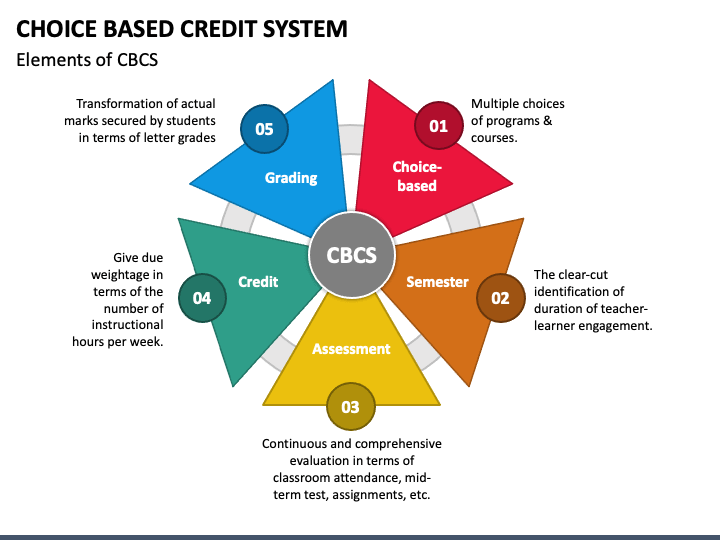
45. What are the advantages of Choice Based Credit System (CBCS) introduced by the UGC for higher education
institutions? (a) Focuses on student-centric education
(b) Allows students to choose inter-disciplinary and intra-
disciplinary courses.
(c) Makes education at par with global standards
(d) Makes it easy to estimate the performance levels of
students in terms of marks.
(e) Offers flexibility for students to undertake studies at
different times and at different institutions.
Choose the correct answer from the options given below: B. (b), (c), (d), (e) only
A. (a), (b), (c), (d) only
D. (c), (d), (e) (a) only
C. (a), (b), (c), (e) only
The correct answer is C. (a), (b), (c), (e) only.
Explanation:
The advantages of the Choice Based Credit System (CBCS) introduced by the UGC for higher education institutions are:
(a) Focuses on student-centric education: The CBCS places emphasis on student-centric education, allowing students to choose courses based on their interests, aptitudes, and career goals. This approach promotes personalized learning and enables students to shape their educational journey.
(b) Allows students to choose inter-disciplinary and intra-disciplinary courses: The CBCS offers students the flexibility to choose courses from different disciplines, encouraging interdisciplinary learning. It also allows students to specialize within a discipline by offering a variety of courses within the same field.
(c) Makes education at par with global standards: The CBCS aligns higher education in India with global standards by adopting credit-based systems that are widely recognized and accepted internationally. This makes it easier for students to pursue further studies or seek employment opportunities abroad.
(e) Offers flexibility for students to undertake studies at different times and at different institutions: The CBCS provides flexibility for students to study at their own pace and convenience. They can choose to take up additional courses, transfer credits across institutions, or even take a break and resume their studies later without losing their academic progress.
The option (d) is incorrect because estimating the performance levels of students in terms of marks is not specifically mentioned as an advantage of the CBCS. The focus is more on personalized learning and student-centric approaches rather than the ease of estimating performance solely based on marks.
Therefore, the correct answer is C. (a), (b), (c), (e) only.

 NTA NET EXAMINATION PAPER I