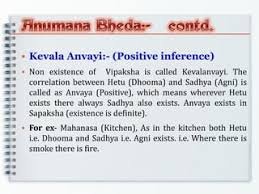
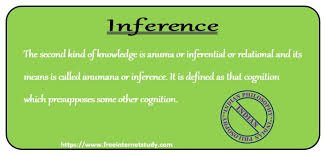
“Kevalanvayi” is a term commonly used in Indian philosophy, specifically in Jainism. It refers to a form of inference or reasoning known as “invariable concomitance” or “universal positive.” Kevalanvayi is one of the two main types of inference, the other being “kevalavyatireki” or “particular negative.”
In the context of Jain philosophy, kevalanvayi refers to a logical process of inference where the presence of a universal or general characteristic in a subject is deduced based on its invariable concomitance with another known object or phenomenon. It asserts that if a certain property is invariably present in a specific set of objects, then it can be inferred to be universally present in all objects of that category.
The concept of kevalanvayi plays a significant role in Jain logic and epistemology, as it is used to establish knowledge and make valid inferences. It helps in the process of understanding the nature of reality and acquiring reliable knowledge about the world.
It’s worth noting that kevalanvayi and kevalavyatireki are complementary forms of inference, and both are used together to arrive at logical conclusions in Jain philosophy.
Please let me know if you would like more information on this topic or if there’s anything else I can assist you with.
Sure! Let’s consider an example to illustrate the concept of kevalanvayi:
Suppose we have observed that every time it rains, the streets become wet. Based on this observation, we can apply kevalanvayi reasoning to infer that if it is currently raining, then the streets must be wet.
In this example, the presence of rain (known as the hetu or reason) invariably accompanies the wetness of the streets (known as the sadhya or predicate). We can establish an invariable concomitance between the two phenomena through repeated observations. Therefore, according to kevalanvayi, we can make a valid inference that if rain is present (universal positive), the streets will be wet.
This inference is based on the understanding that wetness is an invariable concomitant of rain. It allows us to generalize the observation and assert the presence of the predicate (wet streets) whenever the reason (rain) is present.
The concept of kevalanvayi helps in drawing logical conclusions and establishing knowledge by identifying universal connections between phenomena based on their invariable concomitance. It plays a crucial role in Jain philosophy and logical reasoning.
I hope this example clarifies the concept of kevalanvayi. Let me know if you have any further questions!

 NTA NET EXAMINATION PAPER I